
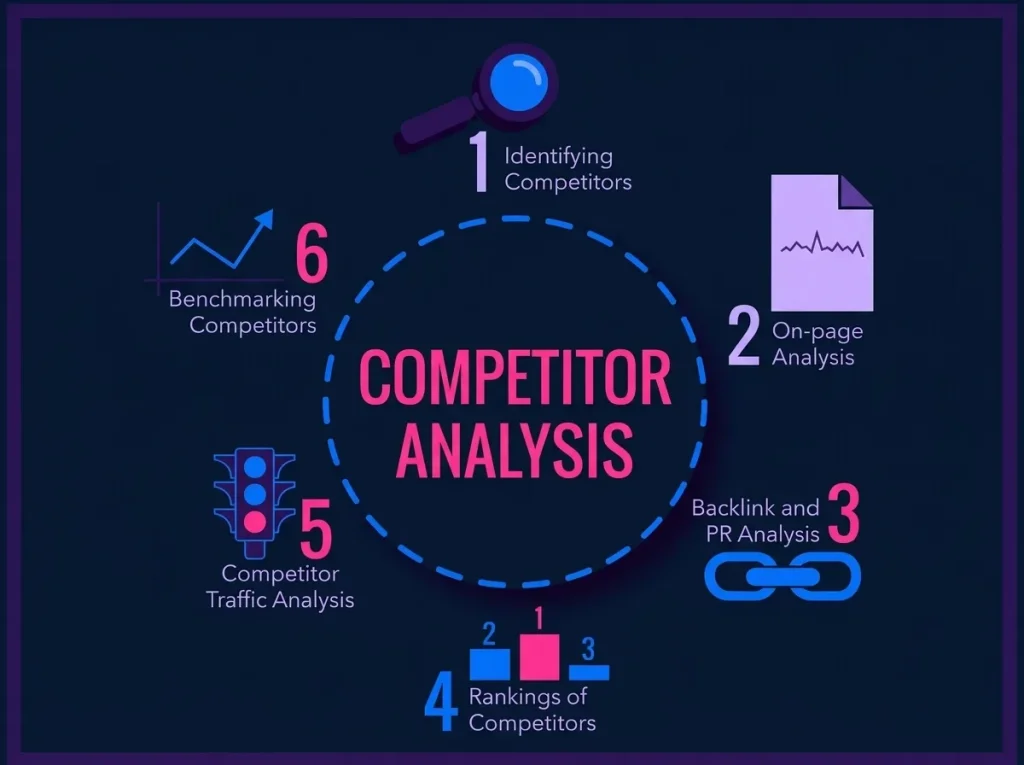
Introduction
In today’s marketplace knowing your competitors is key to business growth. Many businesses spend money on SEO, social media, content marketing and paid ads. They do not always know which tactics their competitors use to attract customers. This is where competitor analysis becomes useful.
Analyzing your competitors’ digital marketing strategies helps you spot market chances understand what customers like boost your presence and make smarter marketing choices. Of copying other businesses you can learn from their strengths spot their weaknesses and build a plan that makes your brand stand out.
In this guide we will explain how to perform competitor analysis of digital marketing strategies step, by step list the tools you can use and show how to turn your findings into a marketing plan.
What Is Competitor Digital Marketing Analysis?
Competitor digital marketing analysis is the process of examining how other businesses attract engage and convert customers through channels. It includes evaluating their website, SEO performance, content, social media presence, advertisements and customer engagement.
For example a local clothing store might analyze competing stores to discover which keywords they target what content attracts engagement and how they promote offers.
The goal is not to copy competitors. Instead it is to understand the market and identify opportunities to improve your digital marketing performance.
Why Is Competitor Analysis Important?
Competitor analysis helps businesses make marketing choices instead of guessing. It shows what customers like and where your business can do better.
Key benefits include:-
- Discovering opportunities: Find keywords that are not well covered unmet customer needs and areas where content is missing.
- Improving SEO: See how competitors rank in search and what backlink strategies they use.
- Creating content: Learn which topics and formats work well and attract your audience.
- Optimizing advertising: Observe how competitors present their offers and highlight their benefits.
- Strengthening your brand: Set yourself apart by offering value that others don’t.
When done regularly competitor analysis helps you stay ahead by adjusting to shifts, in customer behavior and market changes.
7 Steps to Analyze Your Competitors' Digital Marketing Strategies
1. Identify Your Main Competitors
Begin by finding businesses that reach the audience or offer similar products and services. Your competitors can be ones selling the same things or indirect ones solving the same problems.
Search Google using your target keywords. Look at the businesses that appear in the results. Check media platforms and industry directories to find companies that are active in your space.
Make a shortlist of three to five businesses. Focus on those that match your target market your location and your business goals.

2. Analyze Their Website and SEO
Your competitors’ websites give insight into their marketing efforts. Look at their website structure how fast pages load, how mobile-friendly they are how easy it is to navigate their service pages and how they encourage action.
Next examine their search engine optimization. See which keywords they seem to target what topics their blogs. Which pages get the most organic traffic.
Tools like Semrush, Ahrefs and Google search results can help you find keyword opportunities and check their backlink profiles.
Look for gaps in their content. Where can you provide detail, more usefulness or better local relevance? Use these gaps to create content that better meets what users are searching for.

3. Evaluate Their Content Marketing
Content marketing helps businesses educate people build trust and get leads. Look at your competitors’ blogs, guides, videos, case studies and downloadable resources.
Ask these questions:
– What topics do they write most often?
– Are their articles helpful, clear and easy to follow?
– Do they include examples, numbers or expert views?
– Which content types get the engagement?
Find questions your audience has that your competitors don’t answer well. Also look for topics they cover poorly. Create content that offers clearer explanations real solutions and genuine value.

4. Study Their Social Media Presence
Social media analysis shows how competitors talk to customers. Check their activity on platforms like Instagram, Facebook, LinkedIn or YouTube.
Look at how they post what types of content they share, their brand tone, how they interact with followers and their ad campaigns. Notice which posts get engagement.
Don’t judge success by follower numbers. Pay attention to comments, shares, meaningful conversations and clicks to their website.
Use these insights to shape your social media plan. Develop content that fits your brand’s personality and speaks directly to your audience.

5. Examine Their Paid Advertising
Paid ads show how competitors present their offers and attract customers. Use tools like the Google Ads Transparency Center and Meta Ad Library to see their ads.
Look closely at their headlines messaging, ad formats, promotions, landing pages and calls to action.
For example a competitor might highlight consultations, special deals or customer reviews. These can inspire ideas for your campaigns.
Keep in mind that public ads don’t show performance, budget size or conversion rates. Use this research to form ideas then test your ads and measure real results.

6. Review Customer Feedback and Reputation
Customer reviews show what people appreciate and where competitors fall short. Check reviews on Google, industry sites and social media.
Look for patterns in feedback about pricing, service quality, delivery time, communication and support.
If customers complain about replies you can stand out by offering faster communication. If they say pricing is unclear you can improve by being more transparent.
Use feedback ethically. Focus on improving your service not criticizing competitors or making claims without proof.
7. Compare Results. Build an Action Plan
Put all your findings into a simple competitor analysis spreadsheet. Compare each business in areas: SEO, website experience, content, social media, advertising and customer reputation.
Rank the opportunities based on how value they bring to customers your business goals, your resources and how much impact they could have.
For instance if competitors share blogs but have weak local service pages improving your local SEO content could be a smart first step.
Turn each insight into an action, with a deadline. Review your progress every month. Adjust your strategy using real results.

Best Tools for Competitor Digital Marketing Analysis
Several tools can simplify your research:
Semrush:- Research competitor keywords, organic visibility, and advertising information.
Ahrefs:- Explore backlink profiles, keyword opportunities, and competing content.
Google Trends:- Compare search interest and identify changing topic demand.
Meta Ad Library:- Review publicly available advertisements on Meta platforms.
Google Ads Transparency Center:- Explore ads from verified advertisers across Google’s advertising ecosystem.
Google Analytics 4:- Measure your own website traffic, engagement, and conversions.
Some tools offer limited free access, while advanced features may require paid subscriptions.
Common Competitor Analysis Mistakes to Avoid
Do not analyze many competitors if you do not have a clear objective. Concentrate on businesses that matter to your audience and to your goals.
Do not copy competitor content, competitor branding or competitor advertising messages. Use research to spot chances for ideas and to stand out from competitors.
Also do not assume that visible engagement automatically equals profitability. Competitor revenue, conversion rates and advertising returns are rarely available, to the public.
Finally do not treat competitor analysis as a one-time task. Regular reviews help you react to changing customer needs new competitors and evolving marketing trends.
Frequently Asked Questions
Competitor analysis in digital marketing involves evaluating other businesses’ online strategies, including SEO, content marketing, social media, paid advertising, and website performance, to identify opportunities for improvement.
Review your main competitors monthly or quarterly, depending on your industry. Monitor major changes in their content, advertising, and online presence between formal reviews.
Semrush, Ahrefs, Google Trends, Meta Ad Library, and Google Ads Transparency Center are useful tools for researching competitors’ online visibility, content, keywords, and publicly available advertisements.
Yes. Small businesses can use free search tools, customer reviews, and public social media information to discover market gaps, improve local SEO, and create more relevant marketing campaigns.
No. Competitor research should inspire informed decisions, not imitation. Develop original content, communicate your unique value, and test strategies that suit your audience and business objectives.
CONCLUSION
Studying competitors’ digital marketing strategies helps you see what the market looks like spot chances to grow and boost your performance. By looking at websites SEO, content, social media, ads and customer feedback you can make choices.
The best way is to turn research into action. Pay attention to customers track results and create a unique strategy that offers real value.
Ready to Grow Your Business Online?
Want to understand your competition and build a smarter digital marketing strategy? Marketlift can help your business strengthen its online presence, reach relevant audiences, and generate more opportunities through SEO, social media marketing, content marketing, and Google Ads.
Contact Marketlift Today — Let’s build a digital marketing strategy around your business goals.