
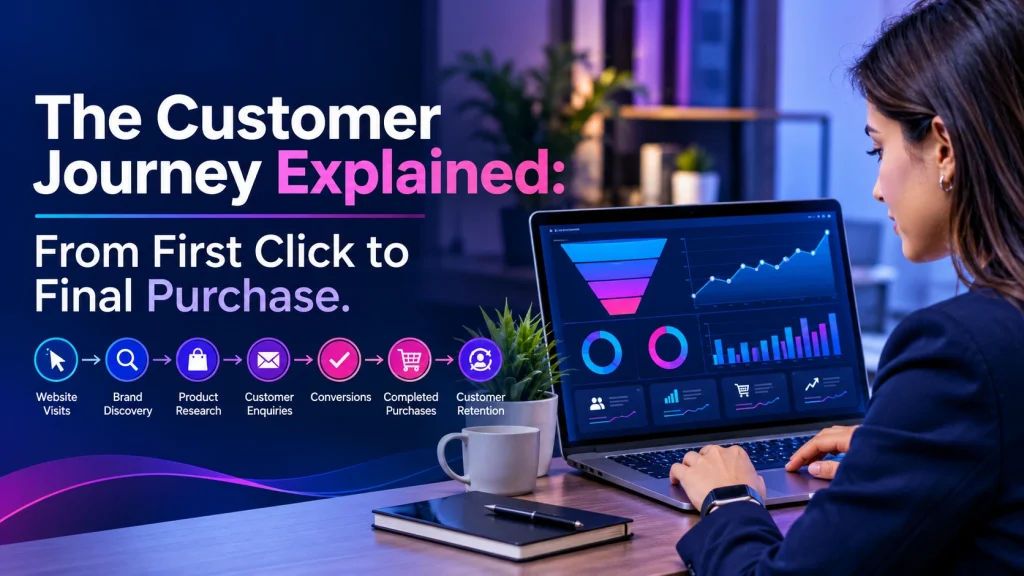
The Customer Journey Explained: From First Click to Final Purchase | Marketlift
<!doctype html> Digital Marketing Guide The Customer Journey Explained: From First Click to Final Purchase By Marketlift•5 min read•For Indian business owners Picture a bakery owner in Lucknow who posts on Instagram every day. People like the photos, but very few place an order. The cakes are not the problem, though. Somewhere between the first glance and the final order, customers hesitate, compare, or lose their way. That path is the customer journey: the complete series of steps a person takes from discovering your business to buying from you and, ideally, returning. Once you understand it, you can see where interest turns into action and where it quietly disappears. What Is the Customer Journey? The customer journey is the full path a person follows while interacting with your business, from first awareness through purchase and beyond. Each point of contact along the way is a customer touchpoint, such as a Google search result, an Instagram reel, a WhatsApp reply, a service page or a follow-up email. ExampleFor example, A family in Jaipur searches for a wedding photographer. Then they find a portfolio website, watch a few reels and read reviews. Finally, they ask for a quote on WhatsApp and book. Together, these steps form one customer journey. Why Is the Customer Journey Important? Customers rarely buy on first contact. Therefore, mapping the journey helps you see your business through their eyes and fix what stands in the way. Specifically, it helps you: ✓ Improve customer experience by removing confusing steps. ✓ Spot conversion barriers early, for example a slow page or a hidden phone number. ✓ Spend your marketing budget where it matters most, instead of guessing. ✓ Build trust, because consistent and honest information reassures buyers. ✓ Encourage repeat purchases, and then referrals, from happy customers. The Five Stages of the Customer Journey 1Stage one Awareness — The First Discovery People first notice a need, and then they discover your business through search engines, social media, content, advertisements or a friend’s recommendation. For instance, a homeowner in Pune searches “how to choose a modular kitchen” and lands on a helpful guide from a local interior designer. To reach people like her, publish useful content, keep your Google Business Profile accurate, and run social media marketing that explains rather than only sells. 2Stage two Consideration — Evaluating Available Options Next, the customer compares. They read reviews, check examples of your work, study your services and weigh prices. Therefore, make that comparison easy. Write clear service descriptions, show genuine testimonials, answer common questions and explain who your service suits. 3Stage three Decision — Choosing a Business At this point, trust matters most. Transparent pricing or price ranges, visible reviews, clear service details and an easy way to get in touch all reduce doubt. Above all, offer one clear next step, like “Book a call” or “Message us on WhatsApp”. 4Stage four Purchase — Completing the Transaction Even a decided customer can leave if buying feels hard. To reduce friction, use short forms, familiar payment options such as UPI, fast mobile pages and a clear confirmation message. Meanwhile, service businesses can treat a booking or enquiry as the purchase. In that case, a simple form or click-to-chat button on a well-built website is often enough. 5Stage five Retention and Advocacy — Building Long-Term Relationships After the sale, prompt support, helpful follow-ups, consistent quality and fair handling of complaints encourage repeat purchases. As a result, satisfied customers may leave genuine reviews or recommend you to others. Remember: journeys are not always linear. For example, a customer may return to comparing options after a poor delivery, or buy again without reconsidering. Therefore, treat the journey as a loop, not a straight line. How Digital Marketing Improves the Customer Journey Different channels support different stages. However, most businesses need only a few at a time. 🔍 SEO Helps people find you while they search and research. See our SEO services. 🎯 Google Ads Reaches people who are actively searching, so it suits consideration and decision. 📱 Social media marketing Builds awareness and, in addition, keeps audiences engaged. ✍️ Content marketing Answers questions, which then moves people toward a decision. ✉️ Email marketing Nurtures enquiries and encourages repeat purchases. 💻 Website development Is where the journey converts, so speed and clarity matter. At Marketlift, we start by finding where customers drop off. Then we choose channels to fit, rather than adding everything at once. Still, results depend on your audience, competition, offer, website quality and execution. How to Measure Customer Journey Performance To judge progress, track the numbers tied to your goals. Website traffic Shows how many people visit, and where they come from. Click-through rate Measures the share of people who click after seeing your ad or listing. Conversion rate Tracks the share of visitors who enquire, book or buy. Cost per lead Is the average spend to earn one enquiry, so it helps you compare channels. Customer acquisition cost Is the total spend to win one paying customer. Customer retention rate Shows the share of customers who keep buying over a period. However, benchmarks vary widely by industry. Therefore, compare against your own past performance. Frequently Asked Questions (FAQs) What are the five stages of the customer journey? A practical model is awareness, consideration, decision, purchase, and retention and advocacy. However, some frameworks merge decision and purchase or add onboarding, so naming varies. What matters most is knowing what customers need at each point. What is the difference between the customer journey and the sales funnel? A sales funnel shows how prospects move toward a sale from the business’s viewpoint. The customer journey, on the other hand, follows the customer’s experience and touchpoints, and it continues after purchase into retention and advocacy. How can small businesses improve their customer journey? First, list every touchpoint. Next, find where people drop off using analytics and customer feedback. Then fix the biggest barrier, such as a slow page or unclear pricing, and measure the change before […]